


By: BRITTANY DAVIS
JT. was finishing the ninth grade when she met Douglas Jackson at a party in South Bend, Indiana, in May of 2014. Although Jackson was 25-years-old, he attended this high school party, telling J.T. that he was only 17. Jackson charmed J.T. at the party and soon afterwards, pursued a romantic relationship with her. He bought her clothes, paid for her to get her nails and hair done, and behaved like the perfect boyfriend.1 J.T. had, from a much older man, what most high school girls crave: attention. He made J.T. feel cared for and desired.
Jackson relied on this position of trust to compel J.T. to engage in commercial sex work. Over the next two months, Jackson transported J.T. to six different states, where she would earn Jackson a profit by having sex with customers. In each of these cities, Jackson solicited purchasers by posting advertisements for J.T.’s “services” on Backpage.com. Jackson controlled the operation: he decided where they would travel, which customers J.T. would meet, and how long the appointments would last. He also took half of the profits that J.T. earned.2
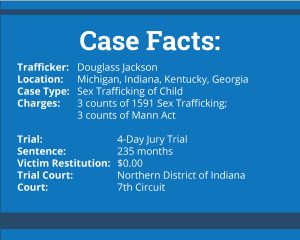 One evening in June, just before midnight, Jackson drove J.T. to a Super 8 motel in Wyoming, Michigan, where J.T. was to meet a man who had responded to an online advertisement that Jackson had posted. J.T. left the hotel room shortly after arriving because she felt uncomfortable during the encounter. She returned to the safety of Jackson’s supervision, smoking weed, and relaxing in the car. While still in the parking lot of the Super 8 motel, J.T. unbuttoned her pants and climbed onto Jackson’s lap.3 Moments later, J.T. and Jackson were interrupted by law enforcement, who had been surveying the motel parking lot. After further questioning, J.T. told the police about her experiences with Jackson and her commercial sex work. The police arrested Jackson for trafficking of a minor for sex.4
Guilty of Sex Trafficking: Sentenced to 235 Months
After a four-day trial in July of 2015, a jury convicted Jackson on three counts of sex trafficking of a minor under 18 U.S.C. §1591(a).5 The trial court sentenced Jackson to 235 months in prison. Under § 1591(a), a defendant can be convicted of trafficking a minor if the defendant: (1) knew – or had a reasonable opportunity to observe – that a victim was under the age of 18; or (2) used force, fraud or coercion to compel the victim to engage in commercial sex. Jackson was convicted of sex trafficking based on his knowledge of J.T.’s age.
Managerial Sentencing Enhancement
Jackson appealed his sentence, arguing that the District Court erred in applying a two-level enhancement to Jackson’s offense based on his role as a manager or supervisor in the trafficking operation. Under U.S. Sentencing Guidelines § 3B1.1(c), a court can enhance a defendant’s sentence if it finds that the defendant was “an organizer, leader, manager, or supervisor” in the criminal enterprise.6 The sentencing guidelines further state that this enhancement applies to those who supervised or organized other “participants” of the crime.7 At issue here is whether Jackson could have supervised or organized another participant, when the only other individual involved in the case was J.T., the victim. Because she was a victim of the trafficking, Jackson asserted that J.T. was not a participant and was not engaged in planning or orchestrating her own exploitation.

Can Victims Be Participants in a Trafficking Scheme?
Circuits are split about whether victims of trafficking can qualify as participants for purposes of the supervisor enhancement. The Ninth and Tenth Circuits8 consider certain potential victims participants where a victim also assists in the facilitation of the trafficking enterprise. Oftentimes these victims were initially exploited by the trafficker, but after some amount of time, are later required to advance the trafficker’s business operation by recruiting potential victims or posting online advertisements to solicit customers. When a victim engages in these activities, or similar methods of assisting in the trafficking enterprise, the Ninth and Tenth Circuits have found that these victims can be considered participants and a trafficker is therefore eligible for the application of the managerial enhancement.9 The First and Second Circuits have gone farther and stated that victims, like J.T., can be considered participants even where the victim was not involved in the exploitation of others.10
The Managerial Enhancement does not Apply to Single Victim/Single Defendant Cases
The Seventh Circuit – in deciding this issue of first impression – departed from the aforementioned circuits and ruled that victims of trafficking should never be considered participants for purposes of the enhancement. In Jackson, the Seventh Circuit recognized that “sex trafficking victims cannot be both victims and participants of their own trafficking.”11 Therefore, because there were no other participants in Jackson’s trafficking enterprise, the Seventh Circuit held that Jackson was not a manager or organizer of a trafficking enterprise and ruled that the district court erred in applying the sentencing enhancement.12
Although the Seventh Circuit’s decision ultimately reduced the length of Jackson’s sentence, it set a strong legal precedent that victims of trafficking should not be considered “participants” of their own exploitation. Keeping this distinction between a victim and a perpetrator in trafficking cases may at times lead to slightly shorter sentences for traffickers, but ultimately ensures that victims are never treated as criminal participants by the court.
- 1 United States v. Jackson, 865 F.3d 946, 948–49 (7th Cir. 2017).
- 2 Id. at 949.
- 3 Id.
- 4 Id.at 950–51.
- 5 Id.at 948.
- 6 U.S.S.G. 3B1.1 (West).
- 7 Id.
- 8 United States v. Scott, 529 F.3d 1290 (10th Cir. 2008).
- 9 See Id. (holding in the Tenth Circuit that a potential victim of trafficking who was involved in the recruiting of another victim can be considered a participant for the purposes of U.S.S.G. § 3B1.1(c)). See also United States v. Smith, 719 F.3d 1120, 1126 (9th Cir. 2013) (holding that a victim of trafficking who took part in the practices of the defendant for other victims could be considered a participant for purposes of the statute).
- 10 United States v. Tavares, 705 F.3d 4, 30 (1st Cir. 2013). See United States v. Cramer, 602 F. App’x 837, 840 (2d Cir. 2015) (holding that defendant’s organization of the activities of his victims was enough for the enhancement of supervisor). See also United States v. Mi Sun Cho, 713 F.3d 716, 722–23 (2d Cir. 2013) (holding that Cho organized six or seven sex workers and taxi drivers which satisfied the requirements for the enhancement).
- 11 Jackson, 865 F.3d at 955.
- 12 Id. at 954.