


By: KATHERINE CAREY
We have all been cautioned that the internet can be a dangerous place. But that vague warning became a reality for Bianca, a 13-year-old girl, who met “Ricky” on MocoSpace, a social networking website. Ricky Davis—also known as “Rick Dog”—was a Mexican man in his early 20s. Having previously been convicted of a felony, Davis was still on parole when he met Bianca. Davis talked to Bianca on social media for over a year before inviting her to his home in September 2011, where Davis offered to give her a tattoo. Excited by the idea, Bianca snuck out to meet him.
When she arrived, Davis told Bianca that his tattoo machine had broken, and instead, she would be “going on dates for money.” Even though Bianca told him she was only 15, Davis forced her to lie on his bed and pose for graphic photos. He revealed his plan to post the photos on “MyRedBook,” a website known for advertising adult services. After sleeping with Bianca to “see how she was,” Davis posted the photos of her online. He then shared her contact information with an interested buyer who responded to the ad.
Investigation, Trial, and Sentence
Before Davis could arrange a date with the buyer, law enforcement officers, responding to reports that Bianca was missing, traced the online photos to Davis’s home. Bianca’s statements from interviews, cell phone forensics, and a visual match of the blanket in the photos to the blanket on Davis’s bed assisted law enforcement in finding and arresting Davis.
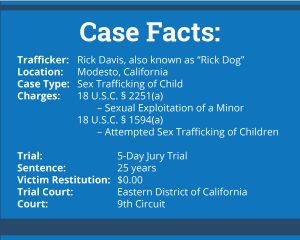 In March 2015, after a five-day trial, a federal jury found Davis guilty of producing child pornography and attempted sex trafficking of a minor. It took the jury only three hours to reach its verdict. Davis was sentenced to 25 years in prison.
Constructive Amendment Challenge
Davis appealed his sex trafficking conviction under § 1591(a), arguing that the District Court’s jury instructions constructively amended the indictment, thereby violating his rights under the Fifth Amendment. A constructive amendment occurs when jury instructions alter the initial charges, allowing a defendant to be convicted of crimes other than those he was charged with. Davis’s indictment stated that Davis could be found guilty of sex trafficking of a minor if he knew that the victim was under 18 years of age or if he recklessly disregarded that the victim was under the age of 18. The jury instructions added a third standard by allowing the jury to find Davis guilty of sex trafficking of a minor if he: (1) knew, (2) recklessly disregarded or (3) had a “reasonable opportunity to observe” Bianca’s age.
The inclusion of this additional standard lowered the Government’s burden of proof. Instead of being required to prove that Davis knew or recklessly disregarded Bianca’s age, the Government only needed to show that Davis’s interactions with Bianca afforded him sufficient opportunity to recognize she was not yet 18. Davis argued that by reducing the government’s burden of proof, this constructive amendment changed what he needed to defend himself against. The Ninth Circuit sided with Davis, and reversed Davis’s sex trafficking conviction. The Ninth Circuit relied on the Fifth Circuit in holding that the “reasonable opportunity to observe” must be explicitly asserted in the initial charging instrument if the government intends to rely on it to convict the defendant. See United States v. Lockhart, 844 F.3d 501, 515-16 (5th Cir. 2016).
Development of the “Reasonable Opportunity to Observe” Standard
In addition to affirming the requirement to expressly include the “reasonable opportunity to observe” standard in the charging instrument, the Davis decision highlighted the development of the mens rea requirement under the Trafficking Victims Protection Act (TVPA). When first enacted in 2000, the TVPA required defendants to know the victim was underage to be convicted of sex trafficking a minor. The 2008 reauthorization expanded the mens rea requirement, allowing defendants to be convicted if they acted in “reckless disregard” of the victim’s age. The 2008 reauthorization also added § 1591(c), which stated, where a “defendant had a reasonable opportunity to observe the [minor] . . . the Government need not prove that the defendant knew that the person had not attained the age of 18 years.”
This language proved ripe for appeals. The Government asserted that “reasonable opportunity to observe” constituted a third independent method to satisfy the mens rea requirement, while defendants argued that § 1591(c) simply modified the “reckless disregard standard.” Circuits were split. Compare United States v. Mozie, 752 F.3d 1271, 1282 (11th Cir. 2014) (adopting defendants’ interpretation) with United States v. Robinson, 702 F.3d 22, 31-32 (2d Cir. 2012) (adopting the government’s understanding). In 2015, Congress resolved the dispute through the Justice for Victims of Trafficking Act (JVTA), which clarified Congress’ intent for the “reasonable opportunity to observe” standard to serve as a third means to prove mens rea under § 1591.1

Sufficiency of Evidence to Meet the “Reasonable Opportunity to Observe” Standard
What evidence is sufficient to prove that a defendant had a “reasonable opportunity to observe” a victim remains uncertain. Circuits addressing this issue have commonly held that the defendant must have had a “direct and personal interaction” with the underage victim. The extent of the direct and personal interaction required varies greatly.2 The Second Circuit found a defendant had a reasonable opportunity to observe the victim where the two were engaged in a three-year, romantic relationship. See United States v. Robinson, 702 F.3d at 27 (defendant had “been together” with the victim every weekend “for like three years” and had discussed her birthday). At the other end of the spectrum, the Fifth Circuit found a reasonable opportunity to observe where the defendant spent only one hour with the victim over a two-day period and never discussed her age. See United States v. Valas, 822 F.3d 228, 235 (5th Cir. 2016). Courts may also consider factors like how close the victim was to 18, how old the victim told the defendant (s)he was, and the nature of the relationship between the defendant and victim.3
Over time, subsequent challenges to this standard will provide further clarity about the sufficiency of evidence required to show that a defendant had a “reasonable opportunity to observe” a victim. In the meantime, the Ninth Circuit reaffirms the requirement that for the Government to rely on the “reasonable opportunity to observe” standard, a defendant must be put on notice of the reduced mens rea standard through express language in the indictment.
- 1 In its current form, 18 U.S.C.A. § 1591(c) states that were a defendant had a reasonable opportunity to observe the age of a minor victim, “the Government need not prove that the defendant knew, or recklessly disregarded the fact, that the person had not attained the age of 18 years.” (Emphasis added.)
- 2 John Cotton Richmond, Federal Human Trafficking Review: An Analysis & Recommendations from the 2016 Legal Developments, 52 Wake Forest L. Rev. 293, 310 (2017).
- 3 Id.; for other examples, see also United States v. Banker, 876 F.3d 530, 540-541 (4th Cir. 2017) (finding the mens rea element satisfied where a mutual friend told the defendant the victim was 17 and the defendant observed the victim in person, had access to her Facebook profile and messages, and knew the victim attended high school); United States v. Phea, 755 F.3d 255, 261 (5th Cir. 2014) (holding the defendant had a reasonable opportunity to observe the victim where the victim did not have an ID to buy a ticket online, defendant spent significant time with victim, and they had intercourse).